Why Digital Customisation Is the Future of Car Personalisation
Car personalisation has always been part of automotive culture. From aftermarket wheels and body kits to interior trims and performance tuning, drivers have long sought ways to make their vehicles feel distinctive. Traditionally, this meant physical modifications — mechanical, visual, or acoustic changes that required parts, tools, and workshop time.
However, the definition of customisation is shifting. Increasingly, personalisation is being driven not by physical alterations, but by software, digital interfaces, and adaptive in-car systems. As vehicles become more technologically advanced, digital customisation is emerging as the next major phase in how drivers shape their cars.
This change reflects a broader transformation in the automotive industry, where vehicles are evolving into software-defined machines rather than purely mechanical products.
From Mechanical Mods to Software Experiences
For decades, car personalisation revolved around tangible upgrades. Alloy wheels, exhaust systems, suspension modifications, and paintwork changes were the primary ways drivers expressed individuality.
While these remain important in enthusiast culture, modern vehicles are introducing a different form of customisation entirely — one that exists inside the software layer.
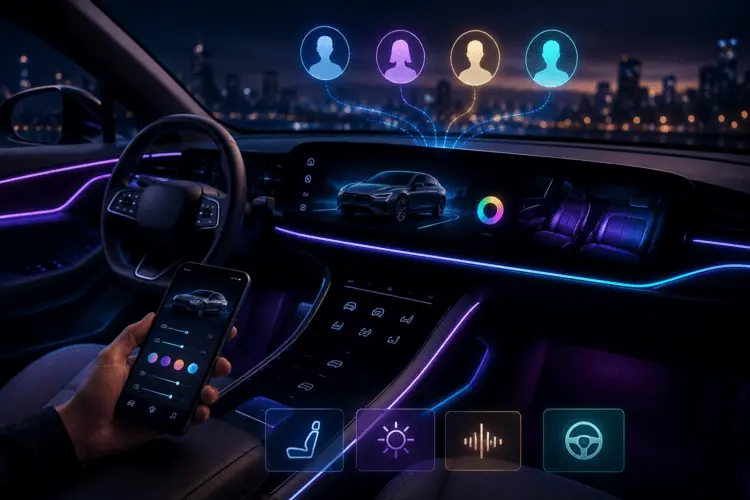
Digital dashboards, infotainment systems, and vehicle control interfaces now allow drivers to change how their cars look and behave without altering any physical components. Display themes, layout configurations, driving modes, and user preferences can all be adjusted instantly.
This shift has fundamentally changed the ownership experience. Instead of static vehicles with fixed characteristics, drivers now interact with systems that can evolve over time through updates and configuration changes.
Adaptive Displays and the Rise of the Digital Cockpit
One of the clearest examples of digital customisation is the modern digital cockpit.
Traditional analogue dials have been replaced in many vehicles by fully customisable screens. These displays can show speed, navigation, performance metrics, entertainment controls, and driver assistance data in different layouts depending on preference.
Some systems allow drivers to prioritise information depending on driving context. For example, a motorway setting might emphasise navigation and efficiency data, while a performance mode may highlight rev ranges, acceleration figures, and handling metrics.
This flexibility turns the dashboard into a personalised interface rather than a fixed instrument panel. In many ways, it mirrors the way smartphones and smart devices have reshaped expectations around user experience.
The car is no longer just a machine — it is an adaptable digital environment.
Ambient Lighting as Emotional Design
Another growing area of digital personalisation is interior lighting.
Ambient lighting systems have moved far beyond simple aesthetic additions. In modern vehicles, lighting can now be configured through software to match mood, driving mode, or even time of day.
Some manufacturers allow drivers to choose from millions of colour combinations, while others link lighting behaviour to driving dynamics. For example, lighting may subtly shift during acceleration, braking, or navigation prompts.
This creates a more immersive cabin experience where emotional design plays a central role. Instead of purely functional interiors, cars are becoming spaces that respond visually to both driver behaviour and preference settings.
The result is a more personalised and emotionally engaging driving environment, shaped by software rather than physical modification.
User Profiles Are Changing Vehicle Ownership
Perhaps the most significant development in digital customisation is the introduction of driver profiles.
Modern vehicles can now store multiple user settings linked to individual drivers. These profiles can automatically adjust seat positions, mirror angles, climate control, infotainment preferences, navigation history, and even driving style settings.
In some systems, profiles are cloud-based, meaning settings can follow drivers across multiple vehicles within the same manufacturer ecosystem.
This transforms the concept of ownership slightly. Instead of each vehicle being a fixed individual experience, cars are becoming adaptable platforms that respond to whoever is behind the wheel.
For households with multiple drivers, this removes friction and creates a seamless transition between users. For manufacturers, it also opens the door to ongoing software-based services and updates that extend beyond the initial purchase.
Over-the-Air Updates and Continuous Customisation
One of the defining features of digital vehicle platforms is the ability to update software remotely.
Over-the-air (OTA) updates allow manufacturers to introduce new features, refine performance, and adjust interface design without requiring a physical dealership visit.
This has major implications for personalisation. Instead of buying a car with fixed features, drivers may increasingly receive new customisation options throughout ownership.
This could include updated display themes, expanded driving modes, improved navigation interfaces, or enhanced driver assistance settings. In some cases, performance characteristics themselves may be adjusted through software calibration updates.
As a result, the car becomes a continually evolving product rather than a static asset.
The Decline of Traditional Modification in Some Segments
While traditional modification culture remains strong among enthusiasts, particularly in performance and classic car communities, digital systems are reducing the need for physical changes in some areas.
Where drivers once installed hardware upgrades to change the driving feel or cabin experience, software now offers alternative ways to achieve similar outcomes.
Driving modes can simulate different performance characteristics. Infotainment systems can completely change the interior ambience. Even sound profiles can be digitally enhanced or modified in electric vehicles.
This does not mean physical modification is disappearing, but it does suggest a shift in where personalisation is taking place. Increasingly, individuality is being expressed through software rather than mechanical alteration.
The Influence of Broader Digital Culture
The rise of digital customisation in cars reflects wider trends in technology and consumer behaviour.
People are now accustomed to highly personalised digital environments through smartphones, streaming platforms, and social media. Recommendation algorithms, custom interfaces, and user-specific content have become standard expectations.
Modern drivers bring these expectations into their vehicles. A car that does not adapt to user behaviour or offer personal configuration options can feel outdated compared to other connected devices.
As automotive technology continues to converge with consumer electronics, the boundary between driving experience and digital experience is becoming increasingly blurred.
Across broader automotive culture, personalisation remains a key expression of identity, whether through design choices, ownership style, or vehicle presentation. In this context, companies like Plates Express reflect the wider emphasis motorists place on individuality and personal expression within the automotive space.
The Future of Car Personalisation
Digital customisation is still in its early stages, but its influence is expanding rapidly.
Future vehicles are likely to offer even deeper levels of personalisation, potentially including AI-driven interface adaptation, predictive comfort settings, and fully dynamic cabin environments that adjust automatically to driver mood and behaviour.
As software becomes more central to automotive design, the car is evolving into a platform rather than a fixed product. This shift opens up continuous opportunities for personalisation long after purchase.
Manufacturers are increasingly recognising that long-term customer engagement depends not only on hardware, but also on evolving digital experiences.
Conclusion
Car personalisation is undergoing a fundamental transformation. While physical modifications remain an important part of automotive culture, digital customisation is becoming the dominant force shaping how drivers interact with their vehicles.
Adaptive displays, ambient lighting, user profiles, and over-the-air updates are redefining what it means to own a car. Instead of static machines, vehicles are becoming responsive digital environments that adapt to individual preferences and lifestyles.
As this trend continues, personalisation will increasingly be defined not by what is added to a car physically, but by how intelligently it can be configured, updated, and experienced through software.