The Complete Guide to Convertible Soft Top Care and Maintenance
Soft top maintenance can go horribly wrong before the first drop of cleaner even hits the fabric. The single biggest mistake owners make is applying the wrong product to the wrong material, and depending on what’s underneath that spray, it can be a costly error to fix.
Convertible tops essentially break down into two product types: woven fabric (mohair or canvas) and vinyl/PVC. They look pretty much the same from 10 feet away, but they’ll behave completely differently when you start to clean and treat them. Fabric tops are breathable and porous; vinyl is smooth and sealed. Apply a fabric waterproofer to vinyl, and you’re leaving a sticky residue that has nothing to absorb it, and that can create a runoff and clog the surface of the material. Apply a vinyl dressing to fabric, and you’re coating the fibers in something that can’t absorb it, which inhibits the material’s ability to breathe and could lead to early failure.
The easiest way to tell them apart is the water drop test. Put a few drops of clean water on an inconspicuous area of the top. If the water beads up and sits on the surface, you’ve got vinyl. If it soaks into the material within a few seconds, you’ve got fabric. That right there decides everything else in your maintenance routine.
How to Clean a Soft Top Without Damaging it
Knowing is half the battle; cleaning is the other half. And it’s the step most people get wrong.
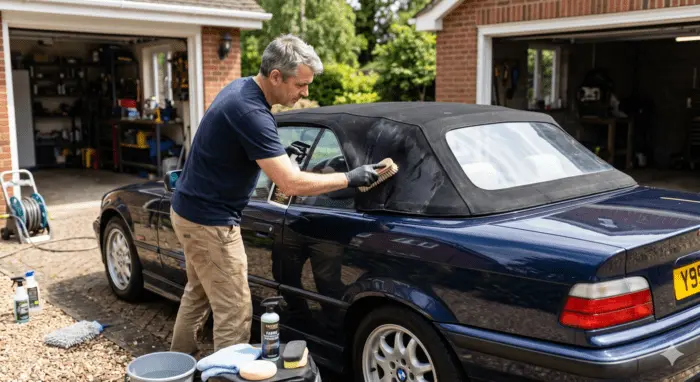
Just as the wrong sort of wax can do more harm than good to your paintwork, the wrong sort of cleaning agent will do immediate, noticeable damage to your top. For fabric tops, that means avoiding household detergents, dish soap, and general-purpose car shampoos. These strip the factory-applied waterproof treatment from the fibers, leaving them exposed and ready to absorb water. For canvas and mohair, you want a low-foaming convertible top cleaner, formulated without solvents, bleach, or alkaline surfactants.
The brush you use to apply it is every bit as important as the cleaner itself. A soft horsehair brush is just stiff enough to agitate the soapy water and cleaner mix without fraying the fibers of the weave or scratching the surface of the top. Stiff nylon brushes are guaranteed to fray and abrade, making short work of the individual threads of a mohair or canvas top and the overall longevity of the roof. For vinyl tops, a damp microfiber cloth and a specific vinyl cleaner is the way to go, and again, scrubbing hard at it serves no purpose. Vinyl scratches a great deal easier than most people think, and fine scratches catch UV light and make the scratching even worse.
If you’re cleaning your car at the same time, use the two-bucket wash method and keep your rinse water separate from your wash water. You don’t want to be dragging road grit over the top when you wash it. Each microscopic abrasive shard worked into a delicate mohair weave is a tear waiting to happen.
Rinse the top thoroughly, then let it dry completely in open air. Don’t lower the top until you’re certain it’s bone dry front to back.
Long-Term Storage and Physical Protection
No amount of cleaning and chemical treatment fully replaces the protection a good, physical barrier offers. Anywhere a convertible is parked, even for just a day and especially overnight or a weekend, it’s subject to every kind of fallout, plus the constant assault of UV radiation.
A well-fitted mazda mx5 car cover made from breathable fabric is the right answer for owners of classic roadsters who store their cars between seasons or park outside regularly. The breathability aspect matters specifically for soft tops; a non-breathable cover traps moisture underneath and creates the warm, damp environment that mold needs to establish itself in the fabric weave.
Custom-fit covers are preferable to universal ones because they don’t shift or flap in the wind. An ill-fitting cover that moves constantly can abrade the top’s surface almost as badly as leaving it exposed.
Before fitting a cover for winter storage, make sure the top is clean, dry, and freshly treated. A cover put over a dirty or damp top will hold that moisture and contamination against the fabric for months.
Applying Waterproof Protection Correctly
The DWR applied in factories isn’t permanent. It is estimated by major convertible top manufacturers that DWR fabric top coatings will degrade within 12 to 24 months of outdoor exposure based on industry performance standards (Haartz). In other words, a reasonably cared-for convertible will need reproofing every two years minimum.
It doesn’t matter how easy the product is to apply if you apply it at the wrong time. The top must be bone dry before you apply any protectant. Those fabric fibers need to breathe; trapping moisture in them makes the perfect environment for rot and mold. Also, don’t try this in direct sun; the UV heat causes the product to dry and cure too quickly before it can penetrate.
Mask off the surrounding paint and glass. Most fabric sealants will leave a haze on glass that’s a nightmare to polish off, and some can be downright harmful to the clearcoat if it’s allowed to sit. This means taping along the hood surround, the window seals, and any chrome or painted trim that sits adjacent to the fabric edge.
Apply in light, even passes. Two thin coats always outperform one heavy coat. Let the top cure for several hours before getting it wet.
Vinyl tops don’t get fabric sealant; they get a UV-blocking vinyl dressing. The objectives are the same (protect against the elements), but the chemistry is different. Look for anything that says UV protection and avoid anything that gives it a high-gloss shine; that’s just more heat being drawn to the top.
Restoring and Protecting Plastic Rear Windows
The PVC rear window is the most vulnerable component of any soft top system. It scratches easily, clouds with UV exposure, and becomes brittle with age. On an old enough car, you can actually crack it if you try to fold the top down too quickly in cold weather.
For light oxidation and surface cloudiness, use a dedicated PVC polish with micro-abrasive particles for clarity restoration. You’ll want to apply it in a circular pattern with a clean microfiber, and gently. A machine polisher is a no-no on flexible plastic; the heat and speed can distort or crack aged material.
For deep scratches, reset your expectations. PVC window polishes are designed for surface scratching, and anything beyond that is straight to the professional assessment or replacement window stage.
After polishing, apply a UV-blocking protectant to slow re-oxidation. Same deal as with the fabric sealant, you’re just building back up the barrier solar radiation has already put a proper beating on.
Clearing the Drainage System
This maintenance task is often forgotten, but it can lead to some of the most costly damage a convertible owner can suffer.
Soft-top roadsters, especially those little two-seaters, are each fitted with an intricate network of internal drainage channels, all designed to catch and redirect through hidden holes any rainwater that manages to penetrate the vehicle’s primary seals. If those holes become clogged with pine needles or leaf debris, the water has nowhere to go except directly into the upholstered cabin.
Your owner’s manual will have this road map as well, but drain-hole locations shouldn’t be too tough to find. They’re simply where the base of the soft top frame meets the body of the car, typically located in the back-quarter areas. A trombone brush (really, that’s what they’re called) will be long enough for most applications. Turn gently when inserting it and twist it as you pull out to hook on the gunk. Flush with low-pressure water to finish the job and confirm the channel is clear.
Do this at least twice a year if the car parks beneath trees. Once one drain backs up into the cabin, you’ve got rusty sills, soaked sound deadening, water-damaged carpets, and a very hefty invoice to contend with.
Rubber Seals and Weatherstripping
The rubber seals surrounding your soft top, along the header rail, window frames, and body aperture, are the difference between “it looks watertight” and “it is watertight”. They are also a maintenance item that most owners will scarcely have touched.
That’s because rubber dries out. It loses flexibility, starts to harden, and eventually begins to pull away from the surfaces it’s meant to seal against. In freezing temperatures, an unprotected rubber seal can bond itself to the glass overnight, and peeling it free in the morning tears the rubber.
Use a specialist rubber conditioner for this job – look for silicone-free formulations specifically made for automotive weatherstripping. Products in this category, like Gummi Pflege, are absorbed into the rubber itself rather than sitting on the surface as a coating. Work the product along every seal with your finger or a soft cloth, giving it time to penetrate.
Do this every three to four months on a daily driver, and before and after any winter storage period.
Frame Inspection and Mechanical Maintenance
The soft top is more than just some fabric; it’s a folding mechanical system with tension cables, hinges, pivot points, and latching hardware that require some TLC, too.
Ensure it’s tight when latched closed by running your hand from the header rail to the tailgate. The skin should be taut and uniform without any low areas. Any sections that trap water or feel slack require an adjustment to the appropriate tension cable, or possibly, a hinge requiring tightening.
Lithium grease is best for lubricating the hinges and pivot points. It works better than generic spray lubes under high heat and pressure and won’t get washed out by rain. Inspect the latching mechanism at the header rail for any signs of wear and ensure it’s drawing the leading edge of the top downward and forward over the frame of the windscreen.
Never force a stiff top. If the mechanism is fighting you, find out why before you push through it. Forcing it risks tearing fabric along the tension cables or cracking a plastic window that’s contracted in cold weather.
Keep the Routine Consistent
A soft top that gets attention twice a year holds up far better than one that gets a complete overhaul every few years out of necessity. The costs that motivate people to finally take care of their convertible top, professional replacement quotes, water-damaged interiors, and cracked rear windows are almost always the result of small, accumulated neglect rather than a single incident.
Clean it regularly, treat the material on schedule, keep the drains clear, and store it under a proper cover. That’s the whole job.