Luis Sanchez Boston Car Accident: A Comprehensive Report on the Seekonk Tragedy and Its Aftermath
Life can change in a single heartbeat. For one Springfield family, a routine Tuesday morning commute became a nightmare that no one could have predicted. The Luis Sanchez Boston car accident remains a painful topic for many in Massachusetts, serving as a stark reminder of the fragility of life on our highways.
On July 2, 2024, Luis Alberto Sanchez Manzo, a devoted father and respected professional, lost his life in a devastating multi-vehicle crash on Interstate 195 (I-195). The incident didn’t just close a major highway; it shattered a community and left coworkers at IDT Corporation mourning a man they described as the “light” of their workplace. This report examines the timeline of that fateful morning, the life of the man we lost, and the lasting impact on those he left behind.
Detailed Timeline of the I-195 Westbound Collision
Understanding exactly what happened requires looking at the specific moments leading up to the crash. The accident wasn’t a simple fender bender; it was a complex chain reaction involving heavy commercial machinery and a personal vehicle.
A Morning That Changed Everything
It was approximately 5:30 a.m. on a Tuesday. The sun was just beginning to rise over Seekonk, Massachusetts, and the early morning commuters were settling into their drive. Traffic on I-195 westbound was moving at its usual steady pace. For Luis Sanchez, this was likely just another drive to work or a scheduled appointment. The weather conditions were clear, and visibility should have been adequate. Yet, in this high-speed environment, the margin for error is often nonexistent.
The Chain Reaction
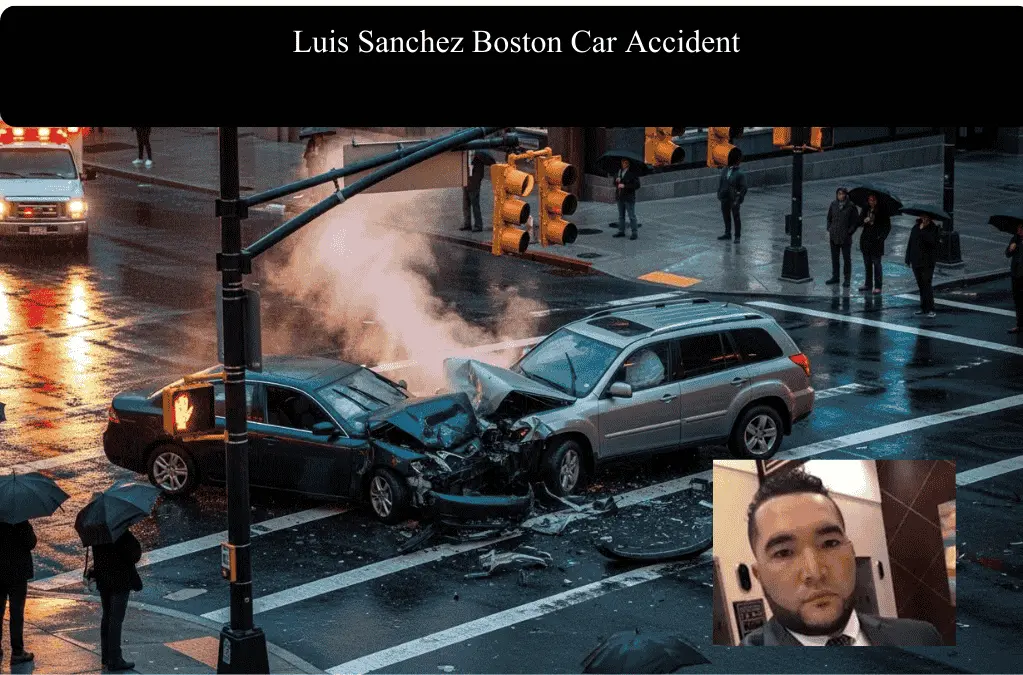
The crash mechanics paint a chaotic picture. Luis was behind the wheel of his 2022 Toyota Highlander, traveling near Exit 1. This specific stretch of highway is known for merging traffic, which often catches drivers off guard.
According to the Massachusetts State Police Collision Analysis and Reconstruction Section (CARS), the sequence began when the Toyota Highlander collided with a Ford F-650. This wasn’t a standard pickup; the F-650 is a medium-duty commercial truck, significantly larger and heavier than a passenger SUV.
The force of that initial impact triggered a deadly chain reaction. Within seconds, a third vehicle—a massive Kenworth tractor-trailer—became involved. The violence of the collision caused the Toyota Highlander to catch fire almost immediately. Emergency responders faced a horrific scene, and despite their rapid arrival, there was little they could do for Luis.
Emergency Response and Aftermath
State Troopers and paramedics arrived within minutes. They immediately shut down all westbound lanes to secure the scene and extinguish the flames. While the driver of the Ford F-650 sustained only minor injuries and the operator of the Kenworth semi-truck walked away unharmed, Luis Sanchez was pronounced dead at the scene. The highway remained closed for hours as investigators worked to piece together the wreckage, snarling traffic for miles and signaling to the wider Boston area that a tragedy had occurred.
Who Was Luis Alberto Sanchez Manzo?
To understand the weight of this loss, we must look beyond the police report. Luis Sanchez was not just a name in a headline; he was a 36-year-old man with a vibrant life in Springfield, Massachusetts.
Background and Career
Luis worked as a Retail Account Manager for IDT Corporation. In the corporate world, it is easy to become just another employee, but Luis stood out. His colleagues didn’t just respect his work ethic; they valued his presence. He was known for his professionalism, but even more so for his reliability. When Luis said he would do something, it got done. He was a pillar for his team, a trait that makes his sudden absence felt even more sharply in the office hallways today.
Personal Retellings: A Man of Laughter
The true measure of Luis’s life is found in the stories his friends and family tell. He was a man who loved deeply and laughed often.
Friends recall his passion for softball, where his competitive spirit was always balanced by his sense of humor. He was the teammate who kept morale high, cracking jokes even when the score wasn’t in their favor.
His family saw the deepest side of his devotion. He was a father who prioritized his children, often seen helping them with homework after a long day at work. His sister shared a particularly touching memory of his support: Luis was always the loudest voice in the stands at her soccer games. It didn’t matter if it was a championship match or a simple practice; he was there, cheering her on with an enthusiasm that embarrassed her then but is cherished now.
Community Impact: Heartbreak and Support
When news of the accident broke, the shockwave traveled fast. It moved from the crash site in Seekonk back to his hometown of Springfield, leaving a trail of disbelief.
Immediate Reaction
The grief was palpable. Neighbors who saw Luis leaving for work that morning couldn’t reconcile the news with the reality. At IDT Corporation, the atmosphere shifted from business as usual to collective mourning. It is rare for a single individual to have such a profound effect on so many different circles, but Luis was that kind of person. He connected with people effortlessly, making everyone feel seen and heard.
Mobilizing Support
In the face of such sudden loss, the community did what communities do best: they rallied. Coworkers quickly organized a GoFundMe campaign to help Sara Sanchez and the children. The goal was not just to cover funeral costs but to provide a financial cushion for a family that had just lost its primary provider.
This type of community response mirrors other tragic events where tight-knit groups have had to come together. We saw a similar outpouring of love following the Jonathan Osteen car accident, where friends and family united to support one another through an unimaginable time. In both cases, the tragedy highlighted that while we cannot predict the future, we can choose how we support one another when the worst happens.
Here is Part 2 of the article.
Official Investigation Status
The Massachusetts State Police Collision Analysis and Reconstruction Section (CARS) has been meticulously working to piece together the events of that July morning. In cases of this magnitude, where a life is lost and commercial entities are involved, the investigation process is exhaustive.
Preliminary Findings
Early reports from the scene indicated that alcohol and drugs were not factors for any of the drivers involved. Both the operator of the Ford F-650 and the Kenworth tractor-trailer remained at the scene and cooperated fully with law enforcement.
However, “accident” implies unpredictability, while “collision” often implies a cause. Investigators are currently focusing on the mechanical data extracted from the vehicles’ Event Data Recorders (EDRs), often referred to as “black boxes.” These devices will reveal critical information about vehicle speed, braking input, and throttle position in the split seconds before impact.
What Investigators Are Analyzing
The reconstruction team is looking at three primary variables:
- Mechanical Integrity: Was the Ford F-650, a commercial vehicle owned by Cintas, in proper working condition? Brake failure or steering malfunctions are often scrutinized in commercial truck crashes.
- Driver Reaction: Did the drivers involved have adequate time to react? The “perception-reaction time” is a key metric in determining if the crash was avoidable.
- Environmental Factors: While the weather was reported as clear, the position of the sun at 5:30 a.m. can create blinding glare for westbound drivers, a factor known as “sun dazzle.”
Legal Implications: The Wrongful Death Lawsuit
While the police determine the cause, the legal system determines accountability. Following the tragedy, Sara Sanchez, Luis’s widow, took decisive legal action to protect her family’s future and seek justice for her husband.
Seeking Justice
A wrongful death lawsuit has been filed naming Nicholas Emond, the driver of the Ford truck, and his employer, Cintas, as defendants. The lawsuit alleges negligence, suggesting that the actions taken by the driver—or the maintenance of the vehicle by the company—failed to meet the standard duty of care required on public roads.
Civil Liability vs. Criminal Charges
It is important to distinguish this civil action from criminal proceedings. As of now, no criminal charges have been filed against Emond. The civil lawsuit focuses on financial recompense for the loss of companionship, future income, and the emotional suffering of the Sanchez family. In Massachusetts, commercial entities like Cintas are often held to higher liability standards due to the size and potential danger of the vehicles they operate. The outcome of this suit will likely hinge on the final CARS report.
Road Safety Analysis: Why Seekonk is a Danger Zone
The Luis Sanchez Boston car accident did not happen in a vacuum. It occurred on a stretch of Interstate 195 that locals know is fraught with danger. The area near Exit 1 in Seekonk acts as a bottleneck where high-speed highway traffic meets merging vehicles from local roads.
Risks on Interstate 195
Highways in New England are often older and narrower than modern standards. I-195 is particularly notorious for its heavy volume of mixed traffic—commuters in sedans sharing lanes with massive 18-wheelers.
- Blind Spots: Commercial trucks have blind spots on all four sides. A small SUV like a Toyota Highlander can easily disappear from a truck driver’s view.
- Stopping Distance: A fully loaded Ford F-650 or Kenworth semi requires up to 40% more distance to stop than a passenger car. In sudden traffic slowdowns, this physics equation often turns deadly.
National Statistics
The National Highway Traffic Safety Administration (NHTSA) reports that nearly one-third of all fatal highway crashes involve multiple vehicles. When heavy trucks are introduced to the equation, the fatality rate for the occupants of the smaller vehicle skyrockets. This tragedy serves as a grim data point in a national crisis of highway safety.
Lessons Learned and Calls for Action
We cannot bring Luis back, but we can learn from the circumstances of his death. Advocacy groups and safety experts are already using this incident to call for systemic changes.
For Policymakers and Drivers
There is a renewed push for “Zero Tolerance” policies regarding distracted driving and stricter enforcement of commercial vehicle inspections. For everyday drivers, the lesson is one of defensive vigilance: never loiter in the “No-Zone” (blind spots) of a truck and always anticipate that traffic ahead may stop suddenly.
Community Resilience
Perhaps the most enduring lesson is one of community strength. Just as we saw with the Jillian Branciforte car accident, a tragic loss for Greece Olympia High School, communities that come together to honor a victim often find a path forward through shared purpose. Whether it is a school rallying for a student or a workplace mourning a colleague, the human spirit’s ability to unite in grief is powerful. The Sanchez family has a long road ahead, but they do not walk it alone.
Conclusion
The Luis Sanchez Boston car accident is a narrative of loss, but also of love. It is the story of a man who “lit up every room,” a family that stands resilient in the face of agony, and a community that refuses to let a neighbor be forgotten.
As the Massachusetts State Police conclude their investigation and the legal battle unfolds in court, the true legacy of Luis Alberto Sanchez Manzo will not be found in legal briefs or police reports. It will be found in the safety changes his death may inspire and the memories cherished by those who knew him best. Let this tragedy serve as a permanent reminder to us all: drive with care, cherish your loved ones, and never take a safe arrival for granted.
FAQs
Where exactly did the Luis Sanchez accident happen?
The accident occurred on Interstate 195 (I-195) westbound, specifically near Exit 1 in Seekonk, Massachusetts, approximately 10 miles from Boston.
Who was named in the wrongful death lawsuit regarding the crash?
The lawsuit filed by Sara Sanchez names Nicholas Emond (the driver of the Ford F-650) and his employer, Cintas, as defendants.
Were there any criminal charges filed in the Seekonk crash?
As of the latest reports, no criminal charges have been filed. The investigation found no initial evidence of intoxication or reckless driving, though the civil lawsuit for negligence is ongoing.
How can the community support the Sanchez family?
While the initial GoFundMe page may have closed, community members are encouraged to support local road safety initiatives in Luis’s name and respect the family’s privacy as the legal proceedings continue.